Is contract risk slowing down the green revolution?

Shifting to green energy is critical for combatting climate change, but investing in low- and middle-income countries is often challenging due to weak contract enforcement. How does this affect investment in renewables?
India offers a useful test case, where solar power production is rapidly expanding but nearly all of the country’s electricity is bought by state-run public utilities. These utilities are often perennially bankrupt and prone to renegotiating contracts, creating a high degree of “counterparty risk” that utilities will default on their obligations.
In a recent paper, EGC affiliate Nicholas Ryan uses a novel dataset to assess the effects of counterparty risk on India’s solar market. The study analyzes solar auctions that were run at the same time: some were run by risky state utilities that often fail to pay their bills and others were intermediated by the central government. He finds that state-level solar auctions – compared to those intermediated by the central government – result in higher prices and less investment. The paper sheds new light on how counterparty risk can “hold up” renewable energy investments, with potentially large implications for the fight against climate change.
In solar power auctions run by India’s state-run electricity utilities, average bid prices are 10 percent higher than in auctions intermediated by the central government.
Intermediation eliminates counterparty risk because the central government has the credibility to pay and the power to urge states to uphold contracts.
Moving all of India from the average state’s risk level to the central government’s risk level could expand the country’s solar supply curve by 20 percent, or 37 percent if moving from a high-risk state’s level (see figure below).
Solar power in India has expanded rapidly in recent years. During the 2010s, the cost of solar panels fell by 82 percent and the country installed 32 gigawatts of solar capacity. But green investments face a high degree of counterparty risk: as technological advances drive down costs, buyers may seek to renegotiate or default on older, more expensive contracts, leading to investor losses. Unless mitigated, these challenges can inhibit investment and increase prices – which, at scale, could slow down the green revolution.
Nicholas Ryan, Assistant Professor of Economics at Yale University and an EGC affiliate, wanted to explore how these dynamics unfolded in India.
Estimating the price of counterparty risk
The primary buyers of nearly all Indian electricity are state-government-owned power utilities, which are often chronically bankrupt and prone to late payments and defaults. Sometimes, however, India’s central government intermediates power auctions on states’ behalf – shielding firms from the state-level risks.
To conduct his analysis, Ryan used a novel dataset covering all of India’s large-scale solar procurement auctions (both state- and central government-run) from 2012 to 2020 – allowing him to compare projects that were built with the same technology, by the same firms, and in the same places, but that were subject to starkly different levels of counterparty risk.
Ryan finds that the average state’s risk increases solar bid prices by 10 percent over what the central government would have paid. This suggests that state auctions pose a substantial risk premium and that firms adjust their bids to account for this elevated risk.
Figure 1: Counterfactual procurement by risk under uniform ceiling prices
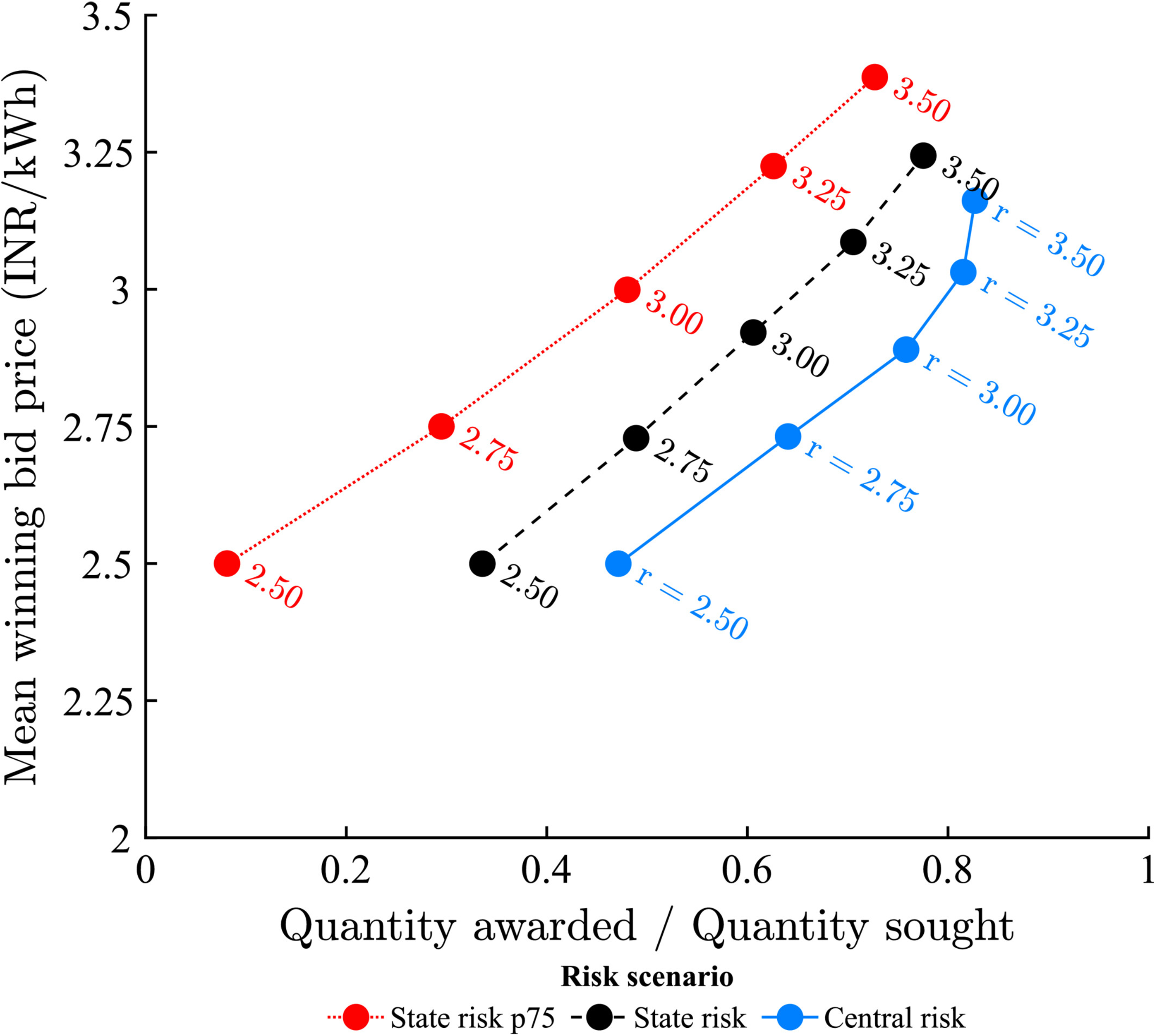
Higher risk reduces investment: solar supply curves under central government risk level (blue solid line), average-risk state (black dashed line), and high-risk state (red dotted line).
How counterparty risk “holds up” green investments
Does counterparty risk ultimately reduce green investments? Ryan finds that it does, since wholesale demand for renewable energy is responsive – or “elastic” – to prices. Buyers routinely choose between energy sources to keep prices low, and these choices affect investment decisions.
To understand these dynamics, Ryan developed a model to estimate India’s solar supply curve under different levels of risk. If all of India hypothetically shifted from the average state’s level of counterparty risk to the central government’s level, the solar supply curve would expand by 20 percent – or 37 percent if shifting from a high-risk state’s risk level.
“Solar investments occur frequently in rich countries like the UK and Germany – some of the least sunny places in the world,” said Ryan. “Why? We think it has to do with the risk of investment. Investors are scared to enter into many low-income countries because the cost of capital is high – and difficult to measure. So that’s what this research is trying to do.”
De-risking the green revolution
Ryan’s paper highlights the obstacles that counterparty risk poses to scaling up green energy investments, particularly in low- and middle-income countries.
The findings suggest that more efforts are needed to reduce risk in green energy markets. The World Bank’s “Scaling Solar” guarantee program, for instance, backs renewable power purchase contracts in high-risk countries – but such efforts are currently far too small to address the challenge of climate change. Nonetheless, Ryan is hopeful.
“Despite this risk and the problems we identify, India is adding renewable energy capacity very rapidly,” said Ryan. “It’s going to set a new record this year, and next year it might set a record on top of that. Can that be replicated in the many other countries that have practically no investment?”
Research Summary by Greg Larson & Maike Pfeiffer
